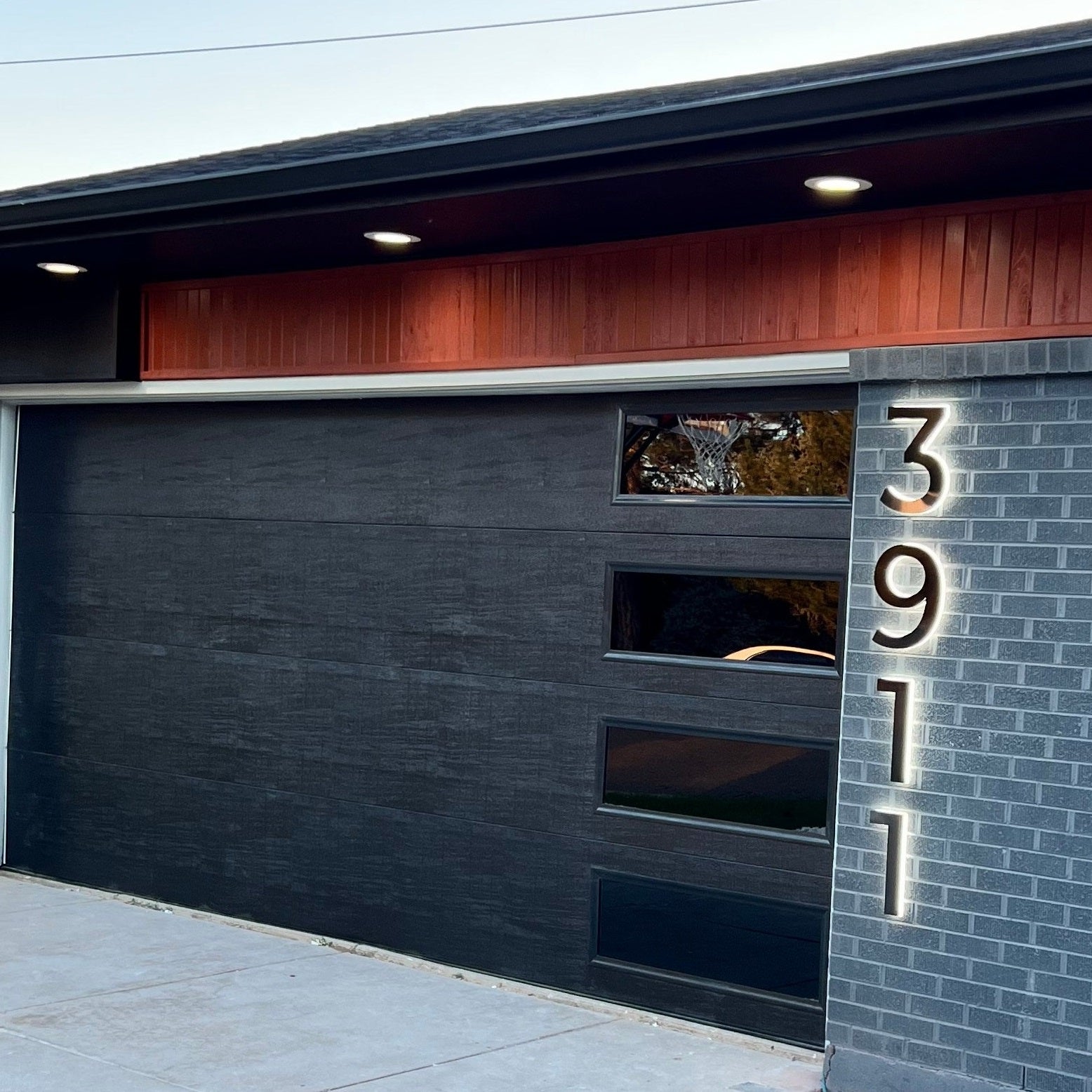
Free-Standing House Address Monuments
An address monument is a free-standing marker that carries your house or business number, set near the entrance of a property rather than fixed to the building. If your house sits well back from the road, behind a gate, or at the end of a long driveway, a monument often solves a visibility problem that numbers on the wall simply cannot.
This guide covers what monuments cost, which materials survive outdoors, how to light one so it actually reads at night, and what to check before you build.
How do you power lighted address numbers on a monument away from the house?
Solar is usually the easiest answer, because a monument normally stands out in the open with no shade, and the solar option arrives as a panel with its own battery bank, so no cable has to cross the yard at all. If a low voltage landscape lighting circuit already runs across the front, a landscape lighting converter lets you feed the characters from it instead. The other route is a low voltage run trenched out from a hardwired or plug-in transformer at the house, and none of these four options calls for an electrician.
What size numbers should I choose for a monument or pillar set back from the road?
Six sizes are made, from 5 inch up to 14 inch, and a monument sitting back from the road wants the larger end of that range rather than the smaller. Bigger characters also hold up better where the road is fast or curved and a driver only gets one glance. Our free size calculator on the dimensions and spacing page will match a size to your own setback before you order.
When a monument is the right answer
Numbers on the house work when a driver can see the house. A monument earns its place when they cannot, or when they will have passed the turn by the time they can.
Consider one if:
- Your house is more than about 70 feet from the road, or is screened by trees or a hedge.
- You share a driveway, or your entrance is one of several close together.
- The approach road curves, so drivers see the property side-on and late.
- You have a gate, and the house number needs to be readable from outside it.
- It is a business, where finding the entrance on the first pass is worth real money.
If your house is a normal suburban setback and clearly visible from the street, a monument is a styling choice rather than a functional one. That is a fine reason to want one, but it is worth being honest about which you are buying.

Materials, and how each one ages
| Material | Holds up | Watch for |
|---|---|---|
| Natural stone or boulder | Indefinitely. Looks better with age. | Heavy, needs machinery to place. Irregular faces make mounting numbers harder. |
| Masonry or stucco pillar | Decades if built on a proper footing. | Stucco cracks if the footing moves. Needs a frost-depth foundation in cold climates. |
| Brick | Decades. Easy to mount numbers into mortar joints. | Mortar needs repointing eventually. Dark brick is a poor background for dark numbers. |
| Powder-coated aluminium or steel post | Long life, light, easy to place. | Cheaper coatings chalk and fade. Check the coating spec, not just the metal. |
| Cedar or hardwood | Handsome, and the easiest to build yourself. | Needs resealing every few years. Ground contact is where it rots first, so use a metal post base. |
| Composite or PVC | No rot, no painting. | Can look plastic up close. Some grades go chalky in strong sun. |
The material decision is mostly aesthetic. The decisions that actually determine whether it still looks good in ten years are the foundation and the drainage underneath it.
What it costs
Ranges vary a lot by region and by how much you do yourself, but as a rough guide:
- A simple post-mounted marker you build yourself: a couple of hundred dollars in materials, plus the numbers.
- A masonry or stone pillar built by a contractor: typically low thousands, driven mostly by the footing and the labour rather than the stone.
- A boulder with numbers mounted on it: often the cheapest striking option if you can source a local stone, though placement usually needs equipment.
- Lighting and power: budget separately, and budget for it at the start. Retrofitting power to a finished monument is the expensive mistake.
Sizing the numbers
A monument sits closer to the road than the house does, but drivers also glance at it for less time. The general rule still applies: roughly one inch of character height per ten feet of viewing distance, and more if the road is fast or curved.
For most monuments set near the property line, 6 to 10 inch characters are the working range. Go to 12 or 14 inches if the marker sits back from the road, if the road speed is high, or if the monument is for a business where traffic is moving at 40 miles an hour and looking for a turn.
Contrast matters as much as size. Dark bronze numbers on a natural stone boulder look beautiful in a photograph taken from six feet away and disappear entirely from a car. If you want a dark finish on a dark stone, plan the lighting first, because the light is what will create the contrast.
Lighting a monument so it actually reads
This is where most monuments fail. A beautifully built pillar with unlit numbers is invisible for half of every day, which defeats the main reason for building it.
Three approaches, in order of how well they work:
- Backlit characters. The light sits behind each number and spreads around it, so the number reads as a solid shape inside a halo. No glare back at the driver, no hot spots, and it works the same in rain and fog. This is the best result on a monument because the mounting surface is usually flat enough to do it cleanly.
- Ground-level uplights aimed across the face. Set them to graze the surface at a shallow angle rather than pointing straight at it. Works well on textured stone. Watch for glare into the eyes of drivers, and for fixtures getting buried by mulch and growth.
- A downlight on a small arm above. Simple, but casts shadows down the face of each character and puts a visible cone of light on the monument.
Whatever you choose, plan the cable route before the footing goes in. Running conduit through a foundation at the start costs almost nothing. Cutting into a finished pillar afterwards is a different job entirely.
Power options for a free-standing marker
A monument is usually away from the house, which makes power the practical constraint.
- Tie into existing landscape lighting. If a low voltage circuit already runs across the front yard, this is the easiest route. Landscape systems are normally 12V AC, so you need a small converter to feed 12V DC characters. Do not connect directly.
- Trench a low voltage cable from the house. More work, but the most reliable result. Do it while the ground is already open for the footing.
- Solar. A genuinely good fit here, because monuments usually sit out in the open with no shade, which is exactly the condition solar needs. Make sure the panel faces south and tilts up, and that you can reach it to clear snow and dust.
Residential and business monuments are different jobs
A residential monument is about being found. A business monument is about being found and being read, often by someone travelling faster, in traffic, deciding whether to turn now.
For a business, size up, keep the number and the name on separate lines with clear space between them, and light it properly. Also check signage rules early: commercial signage is regulated far more tightly than a house number, and rules on height, illumination, setback and total sign area are common.
What to check before you build
- Utility locates. Call before you dig, every time. A monument footing goes deep enough to hit services.
- Setback and right of way. The strip between the sidewalk and the road usually belongs to the municipality, not to you. Building on it can mean being told to remove it.
- Sight lines at the driveway. Many jurisdictions have rules about obstructions near a driveway or intersection, for good reason. A monument that blocks your own view pulling out is a poor trade.
- HOA rules. Where they exist, these often cover height, material, lighting and whether a marker is permitted at all.
- Frost depth. In cold climates the footing has to go below the frost line or the monument will heave and crack.
- Mowing and snow clearance. Leave enough room around the base to work, and think about where the plough throws snow.
The short answer
A monument is worth building when the house cannot be seen from the road in time. Choose the material for looks and the foundation for longevity. Size the characters for the distance and the road speed, not for how they look up close. Plan the power and the lighting before the footing goes in, because that is the part that cannot be added cheaply later.
Our backlit LED address numbers are made to order in six sizes from 5 to 14 inches and six finishes, run on 12V DC from a hardwired, plug-in, landscape or solar power source, and are IP65 rated for permanent outdoor mounting on stone, brick, stucco or wood.